“Equal time” sounds like something you’d think was awesome.
It sounds responsible. Measured. Democratic.
But in American media law, fairness has never been about morality. It has been about structure. And structure is always about power.
When Congress passed the Communications Act of 1934, it wasn’t trying to engineer ideological balance. It was managing scarcity. The airwaves were limited. Not everyone could broadcast. So the government licensed private actors to use public spectrum, on the condition that they serve “the public interest, convenience, and necessity.”
That bargain produced the equal time rule: if you let one legally qualified candidate use your facilities, you must offer others equal opportunity. Access, not agreement. Procedure, not persuasion.
Then came the Fairness Doctrine, which required broadcasters to air contrasting viewpoints on controversial issues. The Supreme Court upheld it in Red Lion Broadcasting Co. v. FCC, leaning heavily on the idea that broadcast scarcity justified regulatory intervention.
But scarcity was always a contingent argument. When media exploded—cable, satellite, internet—the intellectual scaffolding weakened. In 1987, the FCC eliminated the Fairness Doctrine, concluding that it chilled speech more than it protected it.
The equal time rule survived. Narrower. Procedural. A relic of an analog world.
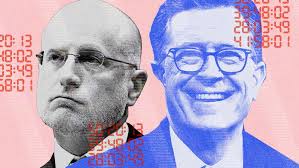
For decades, late-night programs like The Late Show with Stephen Colbert operated under a “bona fide news interview” exemption. Satirical or not, these shows were treated as editorial forums. They could interview candidates without triggering automatic equal time obligations.
Now that interpretation is being reconsidered.
On paper, this is technical. Regulatory housekeeping. A clarification of eligibility for an exemption.
But regulatory reinterpretation is rarely just technical. It’s discretionary. And discretion, when concentrated, becomes leverage.
This is not the Schriftleitergesetz. That law didn’t reinterpret exemptions; it obliterated press independence. It licensed journalists. It racialized eligibility. It criminalized dissent. It fused media with state ideology.
We are not there.
But democratic erosion doesn’t begin with a propaganda ministry. It begins with testing the edges of institutional autonomy.
A licensing body has quiet power. Broadcast networks depend on regulatory goodwill. If compliance becomes unpredictable, if exemptions become politically contingent, if investigations appear selectively motivated, the signal is clear without a single censorship statute being passed.
The First Amendment restrains the government from punishing speech. It does not prevent the government from making speech expensive.
That distinction matters.
Journalism in the United States was never meant to be a fourth branch of government. It was meant to be an adversarial counterweight. Its function is not neutrality; it is friction. It complicates executive power. It informs citizens so that consent is not manufactured but chosen.
When regulatory authority is used in ways that blur that adversarial boundary—even subtly—the ecosystem shifts.
This is where the current moment intersects with Project 2025. The project’s central thesis is not coy: consolidate executive control over the administrative state. Reduce the independence of agencies. Align bureaucratic authority with presidential direction.
Independent agencies only function as guardrails if their discretion is insulated from partisan use. If that insulation erodes, rule interpretation becomes political instrument.
In a fragmented, algorithmic media environment, scarcity is no longer technological. It is attentional. Viewers are not captive to three networks. They inhabit ideological ecosystems of their choosing. The state’s original justification for regulating broadcast access has never looked more outdated.
Yet the licensing regime remains. And where licensing remains, leverage remains.
The question, then, is not whether a late-night host should give equal minutes to every candidate. The question is whether the executive branch should possess expanded interpretive authority over who may platform political speech on broadcast television.
“Fairness” can be a democratic virtue. It can also be a rhetorical shield.
When applied neutrally and predictably, it supports legitimacy. When applied selectively or ambiguously, it chills dissent.
The difference lies not in the statute’s text but in institutional intent.
History rarely repeats exactly. It rhymes in structure. Democratic backsliding seldom announces itself as tyranny. It presents as efficiency, clarification, enforcement. It moves through reinterpretation before it moves through prohibition.
And if you care about systems—if you care about resilience—you have to watch the reinterpretations closely.
Because leverage, once normalized, does not easily return itself to the shelf.
More Information:
Communications Act of 1934 – https://en.wikipedia.org/wiki/Communications_Act_of_1934
Fairness Doctrine – https://en.wikipedia.org/wiki/Fairness_doctrine
Red Lion vs FCC – https://en.wikipedia.org/wiki/Red_Lion_Broadcasting_Co._v._FCC
Schriftleitergesetz (Editor’s Law) – https://arolsen-archives.org/en/news/nazi-germanys-schriftleitergesetz-the-end-of-freedom-of-the-press/