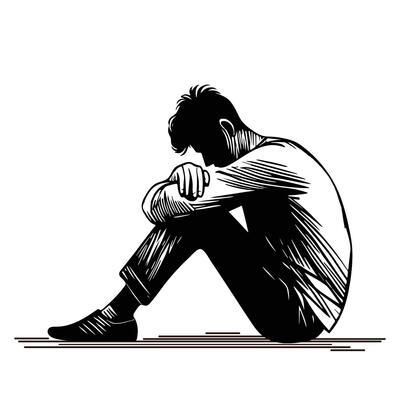
I’ve spent a fair amount of my life wondering whether I should have more friends.
Not necessarily because I’m unhappy or lonely. That’s part of what makes the question difficult to answer, or even really frame. As long as I can remember, I’ve been comfortable spending time alone. Growing up in the military, I moved around a lot and didn’t make many close friends. Either by preference or necessity, I ended up doing my own thing: drawing, writing, reading, or even just thinking. I’ve never been particularly outgoing, but I don’t remember having much trouble socializing when I was around other kids, either. I just didn’t spend much time seeking out their company.
By high school, I remember having a few close friends but feeling fairly isolated. The last major move, involving us going back and forth across the country a couple of times, was particularly difficult. I managed to maintain a few friendships through letters, and three of those connections were important enough that I still remember them distinctly. Most other relationships faded with the circumstances that had brought them into existence.
Even then, I felt that not having enough friends was a kind of personal failure. I thought I should have them. I worried that I might never find anyone who mattered enough to me, or to whom I mattered enough, for a relationship to become something lasting.
What I’ve never really felt, though, is a persistent need to be around people. Even at my most socially engaged, when I was teaching and taking on leadership roles in my hobby groups, people sometimes felt like the price I had to pay for success.
I’ve been thinking about the word aloneliness, which describes the distress that can arise when someone doesn’t get as much solitude as they want or need. It’s a useful concept because it recognizes the positive value of being alone, rather than treating solitude as merely the absence of social connection.
But it leaves me with a question about the other side of that experience: what does it mean when you enjoy being alone, don’t seem to need as much social interaction as other people do, and yet sometimes feel the absence of meaningful connection quite acutely?
I don’t think my experience fits neatly into a single word. What interests me is the tension between wanting solitude, wanting connection, and finding that the things required to maintain one can sometimes interfere with the other.
The difference between being alone and missing someone
My world is very loud. Work, responsibilities, the news, the internet, the general state of everything: it all demands attention, reaction, engagement, and an opinion. I can’t remember a time when the world didn’t feel this way, although I suspect my sensitivity to it has increased as I’ve gotten older. Maybe I’m less resilient than I used to be. Perhaps I’m simply less willing to devote energy to things that don’t feel like they provide value to me.
Whatever the reasoning, quiet has become immensely valuable.
Solitude isn’t just what happens when nobody else is around. It’s a state in which I don’t have to respond to anything. I can read, write, think, or pursue an interest without having to manage another person’s expectations or divide my attention between what I’m doing and what someone else might need from me.
That doesn’t mean I always want to be alone.
I remember having friends over and simply reading in the same room. We weren’t there to have a conversation or do anything in particular. We could each be absorbed in our own book, occasionally acknowledging the other’s presence, without feeling any obligation to make the time together worthwhile. Sometimes it was nice just to have another person in the room. It was companionship that required almost nothing of us beyond being there.
I think I would still enjoy that.
I also enjoy conversations that range across subjects, particularly with people who share my interests and are willing to follow an idea wherever it leads. I can spend hours talking with someone like that and come away genuinely energized, glad the conversation happened and sometimes excited to continue it.
Of course, after those conversations, I still need a day or so to recover.
That recovery isn’t simply a return to my normal state after a pleasant distraction. It’s a response to having pushed myself beyond my comfort zone. The experience was worthwhile, but it took something out of me.
I don’t think that makes the interaction a mistake. It does mean that enjoyment and sustainability are different things. I can want an experience, value it, and be glad I participated without wanting to repeat it tomorrow.
Social expectations don’t always leave much room for that distinction. If you enjoy someone’s company, you’re presumably supposed to want more of it. If you value a friendship, you’re supposed to maintain it. If you miss someone, you’re supposed to reach out.
I understand the logic. I just don’t consistently experience the corresponding impulses.
Out of sight, out of mind
My wife has a phrase for one of my more persistent habits: out of sight, out of mind.
It’s an apt description of what happens with a lot of my friendships. I can receive a message from someone I’m happy to hear from, read it, and then go weeks without responding. Not because I’m upset with the person or have decided the relationship isn’t important, but because I don’t put a response together. My attention moves elsewhere. The message remains unanswered.
Eventually, I remember it. I feel a little awkward about the delay, perhaps mildly guilty, and then respond. Or sometimes I don’t.
This isn’t confined to friendships. Initiating communication is difficult for me at work, too. I far prefer reacting to something that has arrived in front of me to proactively starting a conversation or task. Often, the obstacle isn’t discomfort or fear. It’s that I don’t think about it, get distracted by whatever is immediately in front of me, or struggle to initiate something that has no external deadline or obvious motivator.
I was diagnosed with ADHD in adulthood. That has given me some possible explanations for the way I interact with the world, but it hasn’t changed the experience itself. I’ve been this way for as long as I can remember. Understanding a possible reason for a pattern doesn’t automatically change it, and it doesn’t tell me how much of that pattern I actually want to change.
I can care about someone without thinking about them regularly. I can be genuinely pleased when they contact me and still experience responding as another task competing for my attention. I can want to reconnect and nevertheless fail to initiate the contact that would make it happen.
From the inside, these things coexist, even if they seem contradictory.
From the outside, I know they look quite different.
Someone reaches out, gets no response, and eventually stops trying. Perhaps they decide I’m not interested. Perhaps they conclude that I’m not a particularly good friend. They wouldn’t necessarily be wrong about the observable behavior, even if they misunderstood the reason for it.
I’ve almost certainly lost friendships this way. I can’t identify specific relationships that ended because I failed to follow up, but the pattern is familiar enough that it seems unlikely I’ve escaped the consequences.
My intentions don’t erase the experience of other people. Whatever I feel about a relationship internally, the other person has to make sense of what I actually do.
That seems particularly unfair in one respect: the people most likely to disappear from my life this way are the ones who eventually stop trying to reach me. I may never know that a relationship ended because the other person got tired of being the one to maintain it. From my perspective, we simply lost touch. From theirs, they may have spent months or years trying to keep something alive.
I don’t know how often that’s happened. I just know it probably has.
The relationships that survive
Most of my friendships have originated through work. We spend time together, solve problems, share experiences, complain about the same things, and gradually discover that we enjoy each other’s company. Sometimes the relationship develops a life beyond the workplace.
With one friend, we share an enthusiasm for 3D printing. With another, we share an interest in writing and a tendency to think about politics and the world around us. These relationships have something to sustain them beyond the fact that we once worked together.
But even these friendships are vulnerable to the same pattern. When I leave an environment, I generally leave most of the people in it behind. We might run into each other and say hello, but the relationship doesn’t necessarily continue. There are people I want to stay in touch with, yet I often lose track of the conversational threads once the shared context is gone. Over time, the number of people I maintain a connection with dwindles to one or two.
Work provides a ready-made structure for relationships. There are meetings, projects, common problems, and reasons to talk. Contact happens without anyone having to initiate it from scratch. When the environment disappears, so does much of the machinery that kept the relationship going.
Maintaining the connection then becomes a separate activity, one that requires deliberate effort and a reason to begin. Even when the reason is simply that I’d like to know how someone is doing, that desire doesn’t reliably translate into action.
I don’t think I want friendships that are entirely effortless. I’m not sure such relationships exist, at least not over long periods of time. But I do wish more of my relationships could survive without requiring constant maintenance.
Ideally, I’d be able to acknowledge a message from a friend, let them know I’m glad to hear from them, and pick up the conversation when I have the time and attention to do so. I’d like them to know they haven’t been forgotten in the sense that matters, even if, in practice, I haven’t thought about them in months.
I’d love it if some of these people reached out to me periodically. A message, an unexpected phone call, a link to something they thought I’d find interesting. I’d be happy to hear from them. I’d welcome the reminder that I’m still part of their lives.
But I’d also be aware that responding was another task that needed attention.
There is an uncomfortable asymmetry here. I want people to demonstrate that a relationship matters to them by making the effort to contact me, while I struggle to demonstrate the same thing to them. I want them to understand that my silence doesn’t mean indifference, while knowing that I can’t reasonably expect everyone to interpret it that way.
I would like a friendship in which I can disappear for a while and return without having to explain myself. I also recognize that the other person may need more evidence of my interest than an occasional reappearance provides.
Neither need seems unreasonable. They simply don’t always fit together.
And I don’t think the answer is necessarily to find people who operate exactly as I do. Two people who both struggle to initiate contact might be perfectly comfortable with long stretches of silence, but they might also drift out of each other’s lives without either intending it. Compatibility doesn’t automatically solve the problem.
What I really want is a relationship in which the effort required to stay connected is manageable for both people, even if that effort looks different for each of us. I’m not sure what that would look like in practice, or how much of it is a matter of finding compatible people versus learning to do some things differently myself.
The business of making connections
This is one of the reasons I find professional networking difficult.
The mechanics are much the same as those of friendship: initiating conversations, following up, remembering details, and maintaining relationships over time. But networking often adds a transactional dimension. You’re supposed to establish connections with people partly because those connections might prove useful later.
I understand the practical value of networking. I’ve worked in technology for decades, and professional relationships have mattered throughout my career. Some of the people I consider friends began as colleagues or professional contacts. There is nothing inherently false about that.
The distinction is what happens when a relationship becomes valuable for reasons that have nothing to do with its original purpose. Shared interests and experiences give you reasons to talk that exist independently of work. The connection becomes something you want for its own sake.
Networking often asks you to invest in a relationship before you know whether that kind of connection will develop. You attend the happy hour, make small talk, exchange contact information, and then are expected to follow up. The relationship has to be cultivated, sometimes without any particular reason to want the cultivation beyond the possibility that it might be useful.
For someone who already struggles to maintain relationships with people he genuinely likes, this is a particularly unappealing proposition.
I’d rather have a conversation about something that interests both of us than participate in an exercise designed to manufacture professional familiarity. I’d rather share an experience than demonstrate that I understand the importance of building a network.
The problem isn’t that professional relationships are less genuine. It’s that the expected behaviors are often the same, while the immediate rewards are less apparent to me. The effort is real; the connection is still hypothetical.
I wonder how much of what we call networking is really an expectation that everyone should be able to perform a particular kind of sociability, regardless of whether it suits them or how much capacity they have left for it.
I don’t think there’s a simple answer. Some relationships begin with an exchange of professional value and develop into something meaningful. Others remain useful but impersonal. Neither outcome is necessarily wrong.
What I find difficult is the expectation that I should be equally willing and able to cultivate both, using the same methods, and that my reluctance to do so reflects a deficiency in my understanding of how the world works.
I understand how the world works well enough. Understanding the rules doesn’t mean I find every activity those rules reward worthwhile.
Is this a problem?
I keep returning to the question of whether I should have more friends.
It’s not that I believe everyone should have the same number of friends or that a large social circle is inherently better than a small one. I don’t think there’s anything wrong with preferring solitude. People differ in how much contact they want, how they express affection, how often they need reassurance, and how much effort it takes them to maintain a relationship.
The difficulty is that I don’t always know how to distinguish my preferences from my limitations.
Do I want fewer friendships because I genuinely need less social interaction? Or have I become comfortable with a degree of isolation partly because maintaining relationships has always been difficult for me? Have I learned to value solitude because it suits me, or because it is easier to sustain than the kinds of relationships I sometimes wish I had?
There’s probably a number of factors there, and a lot of therapy.
I don’t think those possibilities are mutually exclusive. Something can be a genuine preference and also be reinforced by the fact that the alternatives are difficult. I can value solitude for its own sake while also finding it a reliable refuge from demands I struggle to manage.
The problem is that I can’t easily separate those things. I don’t have an alternate version of myself to compare against, one who finds it easy to initiate contact, remembers to respond to messages, and maintains relationships without having to think about doing so. I can’t know how much more social I might be if those things came naturally, or whether I’d still choose to spend most of my time alone.
The pattern has been there for as long as I can remember, but it has become more pronounced as I’ve gotten older. Everything seems to have more weight and inertia now. Commitments are harder to take on and harder to put down. The world feels louder, and I’ve become less willing to spend energy on things that leave me depleted.
At the same time, I’ve become less guilty about taking care of myself and more willing to say no. That seems sensible enough. But it also means I’m less likely to override my own preferences simply because I think I should want something.
Sometimes I miss the people I’ve lost touch with. The feeling tends to arrive when I want someone to connect with, when I’d like to share a thought or an experience with someone who knows me. I don’t necessarily spend my days regretting the friendships I failed to maintain. I mostly wish those connections had persisted, so the people would still be there when I wanted them.
There is a difference between wishing you had done more to preserve a relationship and wishing the relationship had survived. The first looks backward toward your own actions. The second looks toward a life in which the connection remained available.
I can regret not having done more without necessarily wishing I’d spent more of my life doing it. I can miss someone and wish they were still part of my life without wanting to return to the work required to maintain the relationship as it was.
That sounds selfish when I put it that way. Perhaps it sometimes is. I don’t think recognizing a limitation automatically makes it reasonable to expect other people to accommodate it. But I also don’t think every relationship that fades represents a failure that must be corrected.
I don’t think the expectation that friends should make an effort to stay in touch is wrong. It’s reasonable, and people are entitled to relationships that meet their needs. But expectations vary across people, minds, and circumstances. What feels like a reasonable level of contact to one person can feel demanding to another. What one person interprets as affection, another may experience as obligation. What one person sees as indifference may be, for the other, an ordinary and largely unremarkable absence from attention.
Understanding those differences doesn’t make them disappear. A relationship still requires some accommodation between the people in it. Sometimes that accommodation works. Sometimes it doesn’t.
I could make a greater effort to reach out, set reminders, and maintain the relationships I value. Those things might help, and perhaps I should do more of them. But I don’t think the whole question can be reduced to a failure of organization or discipline. Even if I became better at staying in touch, I would still value quiet. I’d still prefer a few hours of unstructured time to an afternoon of obligatory socializing. I’d still sometimes want company without conversation, and conversation without the expectation that it must lead to something more.
The question is how much I’m willing to do differently to preserve the connections I want, and how much I’m willing to accept that some relationships won’t survive the way I live.
I don’t know where that balance lies. I suspect it changes with the person, the relationship, and the circumstances. There are people I’d make more of an effort for, and there are relationships I might be content to let fade. I don’t think either choice necessarily tells the whole story about how much I care.
Perhaps the question isn’t whether I should want more friends. Perhaps it’s whether I can find a way of being connected to people that respects both my desire for solitude and my desire for companionship.
I know I don’t want to be entirely alone. I also know I don’t want to spend my life proving that I want to be around people.
I recognize the kind of connection I’m looking for when I experience it. What I haven’t figured out is how to sustain it without turning it into something that feels like another obligation, or how to accept that some of those connections may not survive without more effort than I’m willing or able to give.
Maybe that’s the part I have to keep working out. Maybe some of it is simply a trade-off I have to accept.
For me, that’s all I’ve got.
For my friends, all I can add is: thank you.