
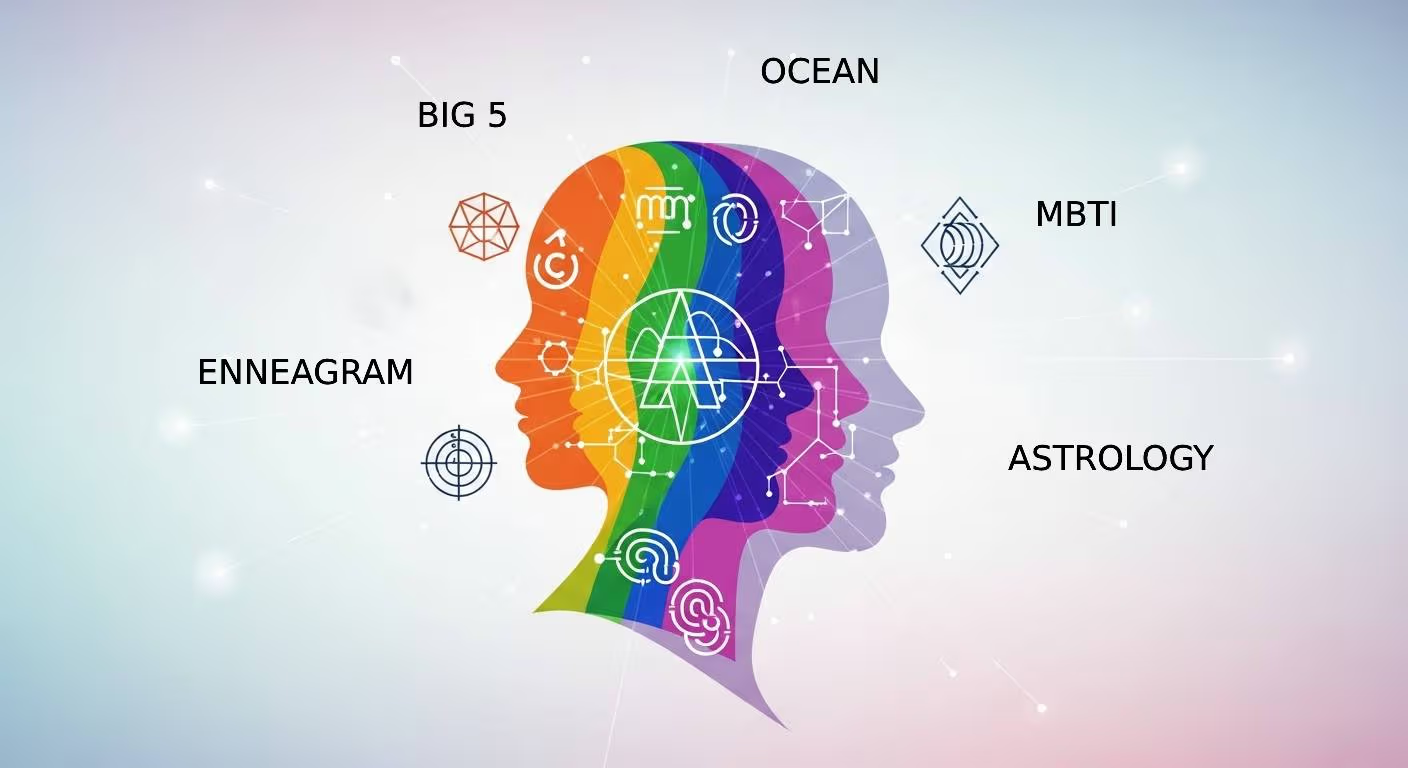
Personality tests are corporate astrology.
That sounds harsher than I actually mean it, but only slightly.
Like astrology, the scientific foundations underneath many workplace personality systems — MBTI, DISC, True Colors, Insights Discovery, Enneagram, and their endless cousins — are often much weaker than the confidence with which they’re presented. They tend to rely on broad generalities, self-reporting, confirmation bias, and interpretations vague and flexible enough that most people can see themselves in multiple categories at once.
Want to test this yourself?
Take the descriptors from one of these personality assessments, remove the labels, randomize the order, and try to determine which category is supposedly “you.”
Years ago, I used to do something similar with horoscopes by intentionally reading the wrong zodiac sign just to see what happened. Unsurprisingly, they were usually just as “accurate” as the one supposedly written for me. The language was broad enough to accommodate almost anyone willing to engage with it honestly.
I recently repeated the experiment with a DISC-style exercise. I stripped away the labels, randomized the behavioral descriptors, and tried to identify which ones actually fit me.
The result? Most of them did.
Not constantly. Not universally. But under different circumstances, stressors, environments, responsibilities, or moods? Absolutely. The same was true for coworkers I tried this with. Human beings are contextual. We are not static character classes in an RPG.
Which is unfortunate, because depending on the day, my personality type seems to alternate between “thoughtful systems thinker” and “racoon held together entirely by calendar reminders and spite.”
People are not static systems with predictable outputs. The same person may react differently depending on stress, trust, psychological safety, burnout, environment, incentives, grief, conflict, novelty, belonging, or exhaustion. Human behavior is adaptive, relational, and contextual. Any framework that treats personality as fixed risks mistaking a snapshot for the whole landscape.
There’s another limitation that rarely gets discussed in workplace settings: most of these frameworks quietly assume a fairly conventional model of behavior, communication, emotional regulation, and social interaction, especially focused on in-person, non-remote work.
They tend to flatten neurodivergence into “style” instead of recognizing it as a fundamentally different way of processing information, stimuli, motivation, or interpersonal dynamics.
An ADHD employee may score differently depending on burnout, masking, novelty, stress, sleep, interest, medication access, psychological safety, or whether they’re operating in crisis mode versus curiosity mode. An autistic employee may appear “reserved,” “analytical,” or “direct” in ways that get interpreted as personality traits rather than differences in communication processing. People who have spent years masking professionally may answer according to the version of themselves they’ve learned is safest or most rewarded in corporate environments, not necessarily the version that is most authentic.
That doesn’t make these people inconsistent. It means the model itself may be too simplistic for the complexity of actual human cognition.
And honestly, that’s part of what bothers me about the confidence these systems are often presented with. Human beings are adaptive. Contextual. Masked. Traumatized. Performing. Exhausted. Evolving. Trying to survive systems that reward some traits while punishing others.
Reducing all of that into four colors and a workshop packet starts to feel less like science and more like organizational fan fiction.
That’s where these systems often lose me: when they stop being reflective tools and start being treated as objective truth.
The problem isn’t that people find meaning in them. The problem is what happens after that meaning is assigned. Once an organization has a label, it becomes easy to stop asking questions. Curiosity gets replaced by categorization. Empathy gets replaced by shorthand.
And at scale, this matters more than it looks like it should.
These tools are not fringe practices. Somewhere around 90% of Fortune 100 companies use some form of personality assessment at some point in hiring, development, or team building. Millions of people a year go through them. Which means this isn’t just about harmless reflection exercises — it’s embedded into how organizations evaluate, sort, and sometimes decide people’s futures.
Which is where things get more uncomfortable.
Because if a system assumes certain “types” are better suited for certain roles, it doesn’t just describe people — it starts filtering them. And once that happens, the advice “just take it for fun” stops being realistic.
People begin optimizing themselves for the test rather than questioning whether the test should exist at all.
That shift matters more than it initially appears to.
Once people start studying how to “pass” a personality assessment, the organization has already crossed an invisible line. The system is no longer being treated as reflective or exploratory. It has become evaluative. Performative. A gatekeeping mechanism dressed up as self-awareness.
Candidates begin learning which answers signal “leadership.” Employees learn which traits are rewarded in promotion loops. Managers begin interpreting disagreement, emotional regulation, communication style, or stress responses through the framework itself instead of through actual context.
The question quietly changes from:
“Who is this person?”
to:
“How legible are they to the model?”
And those are not remotely the same thing.
That is especially dangerous in environments where neurodivergent people are already masking heavily to survive professionally. Many people are not answering these assessments as themselves. They are answering as the safest version of themselves. The employable version. The version least likely to trigger concern, ambiguity, or exclusion.
Which means organizations may believe they are measuring authenticity while actually measuring adaptation to institutional expectations.
If an organization genuinely believes there is a “correct” personality configuration for success, that belief rarely stays contained to hiring.
It tends to shape promotion pathways, communication norms, performance expectations, conflict interpretation, and leadership assumptions. Over time, people who naturally fit the preferred behavioral template advance more easily, while people operating outside it spend increasing amounts of energy translating themselves into something institutionally recognizable.
A workplace like that may initially feel aspirational.
But for many people — especially neurodivergent people — it eventually becomes exhausting.
And organizations persist with these systems for reasons that go far beyond simple belief in their scientific validity.
Personality frameworks solve an institutional problem.
They create the appearance of objectivity in environments filled with ambiguity. They help standardize hiring across thousands of candidates. They reduce complex interpersonal dynamics into manageable categories. They give managers a language that feels analytical, measurable, and defensible — especially in organizations operating at scale.
That level of adoption matters because ubiquity itself starts to manufacture legitimacy. Once enough large organizations normalize a practice, people stop asking whether it meaningfully works and start assuming it must.
But scale is not evidence.
Institutional adoption is not scientific validation.
History is full of systems that persisted not because they were accurate, but because they were administratively convenient.
And I understand the temptation.
Human beings are complicated. Teams are messy. Leadership is hard. Ambiguity is exhausting. These systems offer something deeply seductive: the feeling that people can be made legible.
But legibility is not understanding.
And a model that reduces the cognitive burden of leadership can quietly replace the actual work of leadership — listening, interpreting context, building trust, and revisiting assumptions as people change.
Used carefully, these systems can still have value.
For people who are not naturally introspective, they can provide structure for reflection. They can create vocabulary for discussing communication styles, conflict patterns, motivation, stress responses, or blind spots. Sometimes the value isn’t in whether the category is “true,” but whether it creates enough distance for someone to examine themselves honestly.
That has real utility.
A hot-headed person may pause before reacting because they’ve been encouraged to reflect on how they show up under stress. A conflict-avoidant manager may realize they soften feedback to the point of ambiguity. A team may develop a shared language that reduces friction, even if the underlying model is scientifically fuzzy.
But that value requires humility about what these systems actually are.
They are prompts, not diagnoses.
Conversation starters, not immutable truths.
Maps, not territory.
Used carefully, they can encourage reflection and empathy.
Used carelessly, they become corporate phrenology with prettier branding, a color palette, and a consultant invoice attached.
Once labels become institutionalized, people stop interacting with coworkers as dynamic human beings and start interacting with abstractions. “The analytical one.” “The difficult one.” “The visionary.” “The conflict avoider.” Categories become shortcuts for curiosity.
And shortcuts are seductive to overstretched organizations because genuine understanding is expensive.
The danger isn’t that these systems exist.
The danger is treating them as comprehensive explanations for human behavior instead of what they really are: simplified models attempting to describe impossibly complex people.
That feels much closer to astrology than science.
But even astrology occasionally gets someone to look up at the sky and think about their life for a minute — which is probably more reflection than most workplaces make time for anyway.